
Best Binoculars For African Safari – 2026 Reviews

You’re in a Land Cruiser at 6:40 a.m., the light is still grey, and someone up front says “lion, left of the acacia.” Everyone lifts glass at once. That moment – seconds long, in poor light, on a moving target – is what separates a binocular that earns its spot in your daypack from one that only looked good in a product photo.
Two things drive that difference. The first is low-light capability, which comes down to objective lens size, coating quality, and prism design – the reason a 42mm binocular beats any compact once the sun drops. The second is steadiness, and that’s mostly a magnification story: 8x and 10x you can brace in a vehicle, 12x and up you mostly can’t. Weather sealing, eye relief, and how the thing hangs off your body fill in the rest.
What follows is a survey of the safari binocular market, not a tour of one brand’s catalogue. Some picks are built for dust and rough handling, some for spectacles and shared use, and one is a deliberate cheap-and-cheerful backup. Match the glass to how you’ll actually travel and you’ll stop thinking about the binoculars entirely.
Best Binoculars for African Safari – 2026 Reviews

Crossfire HD 10×42 – HD Optics with Chest Harness Included
A 10×42 roof-prism binocular built for long days outdoors: HD glass elements, fully multi-coated lenses, nitrogen purging, and rubber armor that shrugs off knocks and recoil. Vortex ships it with a GlassPak chest harness, which matters more on a game drive than most spec sheets admit.

Nature DX 8×42 – Wide, Steady Views for Glasses Wearers
An 8×42 roof-prism binocular with phase-coated BaK-4 prisms and a genuinely wide field of view. The lower magnification and long eye relief make it the friendliest option for glasses wearers and for anyone tracking animals from a moving vehicle.

H2O Xtreme 10×42 – Submersible Build, Light Carry
A 10×42 roof-prism binocular with BaK-4 prisms, fully multi-coated lenses, and an IPX7-rated body rated to survive accidental submersion. Light for its class, with rubber armor and a center-focus wheel you can work one-handed.
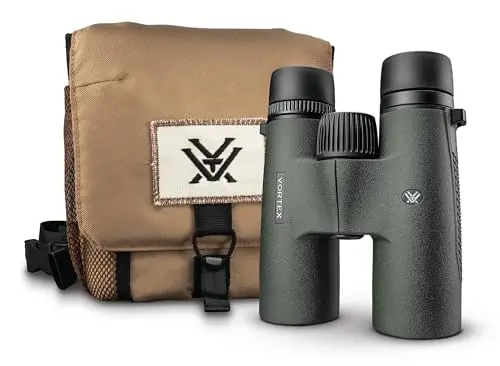
Triumph HD 10×42 – Budget HD Glass with Field Harness
A full-size 10×42 with an HD optical system, fully multi-coated lenses, and a polycarbonate chassis wrapped in rubber armor. Ships with a neck strap and an adjustable GlassPak harness, and carries the same unconditional lifetime warranty as Vortex’s pricier glass.

12×42 Binocular Kit – Phone Adapter and Tripod Included
A 12×42 roof-prism binocular with BaK-4 prisms, fully multi-coated lenses, and an IPX7-rated body. It arrives as a kit: universal phone adapter, a swivel tripod, and a crossbody case with a phone pocket, aimed at people who want photos as well as views.

10×25 Compact – Pocket-Sized Backup Glass
A palm-sized 10×25 porro-prism binocular weighing around 0.6 pounds, with BaK-4 prisms and a 60-75mm interpupillary range that fits kids and most adults. Built for gloveboxes, daypacks, and long transfers when the big glass stays in the case.

12×25 Compact – One-Hand Reach in a Pocket Body
A 12×25 compact with FMC-coated optics and oversized 15mm eyepieces, sized for one-handed use. Aimed at travellers who want more reach than a pocket 10x but still want something that fits a jacket pocket or a saddlebag.
How We Evaluated These Safari Binoculars
A few things we can’t tell you: how each of these binoculars holds up after a week of dust, heat, and daily vehicle transfers. What we can: we cross-referenced seven binocular models from six distinct brands against the conditions an actual safari throws at glass, and mapped them across seven decision axes – magnification-to-objective ratio, low-light brightness, field of view, weather and dust sealing, eye relief and eyecup comfort, weight and carry ergonomics, and warranty support. Compact models were judged on backup duty rather than as primary glass, because a 25mm objective simply can’t compete at dawn.
We triangulated published specifications, feature sets, and owner feedback where available, then benchmarked every option against the others rather than against a single brand’s lineup. Where published specs were ambiguous, we said so rather than guessing. The scoring weighted real-world safari fit (70%) – whether a binocular actually delivers a usable image in low light from an unsteady platform – against feature differentiation (30%) – the extras that change how you use it, like an included chest harness, a tripod socket, or a phone adapter. We have no commercial relationship with any of these brands; recommendations track fit and differentiation, not brand preference. If you want the safest all-round choice, the Crossfire HD 10×42 is it. If you wear glasses and want the widest, calmest view, the Nature DX 8×42 is the better route.
How to Choose the Right Safari Binoculars
1. Why 8×42 and 10×42 Binoculars Dominate Safari Lineups
The shorthand is simple: the first number is magnification, the second is objective lens diameter in millimetres. 8×42 and 10×42 dominate safari packing lists for a reason – a 42mm objective gathers enough light for the half hour after sunrise and before sunset, when animals actually move, and 8x to 10x is the most magnification most people can hold steady without a rest.
Do the exit-pupil math and it becomes obvious: divide objective size by magnification and you get the width of the light column reaching your eye. A 10×42 delivers about 4.2mm, an 8×42 about 5.25mm, and a 12×25 compact manages 2.5mm. In flat midday light that gap barely shows. At dawn it’s the difference between a shape and a species. If you want the most affordable route to a proper 10×42 with a chest harness in the box, the Triumph HD 10×42 is the pick here.
2. Low-Light Brightness: The Safari Spec That Actually Matters
Guides start early and finish late, and the light in between is not the light in the brochure photos. Low-light performance comes from three things: objective size, coating quality, and prism design. Fully multi-coated lenses – coatings on every air-to-glass surface, not just some – are the baseline you should insist on. BaK-4 prisms beat cheaper BK-7 glass for edge brightness and colour fidelity, and on roof-prism binoculars, phase coating is the upgrade that lifts contrast noticeably.
None of that rescues a small objective. A 10×25 or 12×25 is fine at 10 a.m. and frustrating at 6 p.m., so treat small binoculars as backup rather than primary glass. A 42mm objective is the practical floor for a safari primary.
3. Field of View and Magnification: What Works From a Moving Vehicle
Field of view is quoted either in degrees or in feet at 1,000 yards, and it decides how fast you can find what your guide is pointing at. A wider field of view means less scanning and less swearing. Eight-power binoculars are inherently wider – the Nature DX 8×42 at 7.4 degrees is the widest option in this group – while 12x designs trade view width for reach.
Magnification also costs stability. Every bump in a game-drive vehicle is amplified by the same factor as your subject, so 10x is close to the practical ceiling handheld. More power than that wants a beanbag, a window mount, or a tripod.
4. Dust, Heat, and Rain: Sealing and Build Quality for Safari Conditions
Safari is a torture test in a mild climate’s clothing. Dust gets into everything, and the swing from an air-conditioned vehicle to 40-degree heat fogs cheap optics instantly. Nitrogen purging plus o-ring seals is the combination that prevents internal fogging, and it’s non-negotiable here. IPX7 ratings go further, certifying the body against accidental submersion – worth having if your itinerary includes boats or mokoro rides.
Rubber armor does two jobs: it protects the optics from roll bars and rock plates, and it stops the barrel sliding out of sweaty hands. A textured, non-slip finish matters more than the marketing photos suggest. If water is genuinely in the plan, the H2O Xtreme 10×42 is the full-size pick for that job.
5. Eye Relief, Eyecups, and Sharing Binoculars With a Group
If you wear glasses or sunglasses, eye relief is the number that decides whether you see a full circle or a keyhole. Anything under about 15mm gets tight; 17mm and up is comfortable. Twist-up eyecups are far easier to live with than rubber fold-downs, especially when binoculars get handed back and forth across a vehicle.
Group trips also need interpupillary distance range – the gap between eyepieces. Most adults fit somewhere between 58mm and 74mm, but a broad range lets kids and smaller adults share. A diopter adjustment handles the difference between your two eyes. If glasses are a permanent fixture, the Nature DX 8×42 is the most forgiving setup in this lineup.
6. Budget, Mid-Range, and Premium Binoculars for Safari
The budget tier gets you functional glass, adequate coatings, and a warranty of varying quality. That’s a reasonable place to start if safari is a one-off trip. The mid-range is where coatings, prism quality, and sealing genuinely improve – and where a proper harness and a lifetime warranty start showing up. The premium tier buys optical refinement, lighter chassis materials, and edge-to-edge sharpness that most people notice only side by side.
Be honest about frequency. A once-a-decade trip doesn’t need premium glass; a guide, ranger, or anyone out monthly should care a lot about warranty and sealing. And if you want to bring photos home rather than just memories, the Adasion 12×42 bundles a phone adapter and tripod that would cost extra on their own.
Frequently Asked Questions
1. Are 8×42 or 10×42 binoculars better for an African safari?
Neither is wrong; they solve different problems. 10×42 gives you more reach for open plains and distant sightings, which is common in Namibia and the Kalahari. 8×42 gives a wider field of view and a brighter exit pupil, which makes it easier to find moving animals and steadier to hold from a vehicle.
If you wear glasses, or you’re sharing one binocular with a partner, 8×42 is the safer call – the Nature DX 8×42 is the obvious pick. If open-country distance matters most and your hands are steady, go 10×42.
2. How do the Vortex Crossfire HD and Celestron Nature DX compare for safari?
They’re the two best-balanced options here and they split on priorities. The Crossfire HD is a 10×42 with an included GlassPak harness, a lighter body, and an unconditional lifetime warranty – the more forgiving package for hard use and rough handling. The Nature DX is an 8×42 with the wider view, phase-coated prisms, and more generous eye relief, which suits glasses wearers and anyone who values stability over reach.
Pick the Crossfire for durability and reach; pick the Nature DX for view width and comfort.
3. Is 12×42 too much magnification for a safari binocular?
Not too much, but it’s a compromise. Twelve power narrows the field of view and amplifies every shake, so it works far better on a window mount or tripod than handheld from a moving vehicle. Where it earns its place is reach: if you’re glassing open country and you have somewhere to rest, 12×42 pulls detail a 10x won’t.
For most people, 8x or 10x is the more useful safari choice. A 12×42 like the Adasion makes more sense as a photo rig than as your only glass.
4. How do the Bushnell H2O Xtreme and Vortex Triumph HD compare?
Both are 10×42 roof-prism binoculars with nitrogen purging and rubber armor, and both target the same buyer. The H2O Xtreme leans on sealing – an IPX7 rating for accidental submersion and a lighter 709-gram body – while the Triumph HD leans on optics and support, with HD glass elements, a chest harness in the box, and a transferable lifetime warranty.
Wet, boat-based itineraries favour the Bushnell. Dry, dusty overland trips favour the Vortex.
5. Can small binoculars like the Hontry 10×25 work on safari?
They can, with caveats. A 25mm objective produces a small exit pupil, so anything after sunset or before sunrise gets dim fast – and that’s when a lot of the good sightings happen. What compacts do well is availability: a 0.6-pound pair that lives in a daypack gets used on transfers, in camp, and at the waterhole in decent light.
Treat one as a backup, not your primary. The Hontry 10×25 is a sensible second pair for that job.
Final Verdict
For most safari trips, the Vortex Crossfire HD 10×42 is the answer. It covers the two things that decide whether you see the animal – a proper 42mm objective for low light and a GlassPak harness that keeps it ready – and backs it with a warranty that makes the outlay easier to justify.
If you wear glasses or you’re splitting one binocular between two people, the Celestron Nature DX 8×42 is the better route: wider view, more eye relief, steadier image. On a tighter budget, the Bushnell H2O Xtreme 10×42 gives you real waterproofing and a light body without stepping down much optically. And if you want footage as well as views, the Adasion 12×42 bundles the adapter and tripod that turn it into a photo rig.
Match the glass to how you’ll actually travel, and you’ll stop thinking about the binoculars and start watching the bush.
